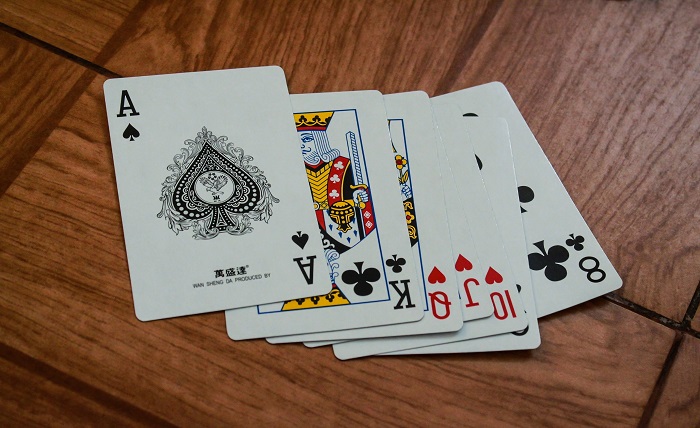

Call Break is one of those card games that becomes much easier once you stop thinking about individual cards and start thinking in tricks.
Four players receive 13 cards each. Spades are trump. Before play begins, every player makes a call for the number of tricks they expect to win.
From there, the challenge is straightforward: make your call without giving away more tricks than necessary.
The rules are not difficult, but three parts tend to cause confusion for new players — following suit, using trump cards and understanding what the original call means for the final score.
The whole deck is dealt
Call Break is normally played by four players using a standard 52-card deck.
There are no jokers.
With four players at the table, the deck divides evenly:
52 cards ÷ 4 players = 13 cards each.
There is no draw pile left in the middle. Once the cards have been dealt, those 13 cards are what each player has to work with for the round.
Cards follow the usual high-to-low order:
A, K, Q, J, 10, 9, 8, 7, 6, 5, 4, 3, 2
The ace is high.
Your call comes before the first trick
Before cards are played, each player makes a call.
The call is simply a prediction of how many tricks that player expects to win during the round.
A player holding several strong spades and high cards might make a higher call. A weaker hand usually calls more cautiously.
Suppose a player calls 4.
That number becomes the player’s target. Winning four tricks reaches the call. Winning fewer than four means the target has been missed.
This is what separates Call Break from a simple trick-taking contest. The aim is not merely to collect cards or blindly win as many tricks as possible. Players are trying to manage the hand around a target they declared before the play began.
Following suit comes first
Each trick begins when one player leads a card.
The other players then play one card each.
If you hold a card of the suit that was led, you must follow that suit.
For example:
Lead: 10♥
If you have any hearts, you must play a heart.
You cannot ignore the suit and throw a spade simply because you would rather use a trump card.
Once all four cards have been played, the highest valid card wins the trick and the winner leads the next one.
For players learning the game, TaashKhel’s guide to Call Break rules gives a fuller walkthrough of the deal, calls, trick play, trump rules and scoring.
Spades are always trump
Unlike some trick-taking games where the trump suit changes from round to round, Call Break traditionally uses spades as the permanent trump suit.
That makes every spade potentially important.
If a trick contains no trump card, the highest card of the suit that was led wins.
If a valid spade is played into the trick, however, the highest spade wins.
Imagine this trick:
Player 1: K♦
Player 2: A♦
Player 3: 4♠
Player 4: 7♠
Although the ace of diamonds is the highest diamond, it does not win.
The 7♠ takes the trick because spades are trump and it is the highest trump card played.
When can you use a trump card?
This is where many casual games develop slightly different table habits.
The basic principle is that players must follow the led suit when they can. When they cannot, the trump rules determine what cards may be played.
That makes it worth agreeing on the exact table rules before beginning, particularly if players come from different regional versions of Call Break.
What does not change is the importance of spades.
A low spade can defeat a high card from another suit when it is legally played as trump. At the same time, wasting strong spades too early can leave a player without control later in the round.
Winning a trick is not always the difficult part
A new player may look at an ace and assume it represents a guaranteed trick.
It does not.
An ace can lose when another player cannot follow suit and is able to use a trump card.
Likewise, a hand full of middle-ranking cards may perform better than expected if the suits are distributed favourably.
That is why the call happens before play. Players have to estimate the strength of the entire 13-card hand rather than judge cards individually.
Strong spades matter.
High cards matter.
Suit length matters.
But none of them works in isolation.
Your call changes how you play the hand
Suppose two players each have already won three tricks.
One originally called 3.
The other called 6.
Their situation is completely different.
The first player has already reached the declared target. The second still needs another three tricks.
That changes which cards are worth protecting, when trump cards should be used and how aggressively each player needs to contest the remaining tricks.
This is one of the reasons Call Break becomes more interesting after the basic rules are learned. The cards determine what is possible, but the call determines what each player needs to accomplish.
What happens when the call is missed?
Scoring systems can vary between versions, but the central idea remains consistent: reaching the declared call is important.
If a player calls four tricks but finishes with only three, the call has not been completed.
Extra tricks after reaching a call may also be treated differently depending on the scoring system being used. Some versions count them as smaller additional values, while particular apps or local tables may use their own scoring conventions.
For that reason, players should check the scoring method before beginning rather than assume every Call Break table calculates overtricks identically.
The actual trick-taking rules are much more consistent than the scoring variations.
A full round has 13 tricks
Because every player begins with 13 cards and plays one card into every trick, a complete round contains exactly 13 tricks.
After the thirteenth trick, all cards have been played.
The players then compare the number of tricks won with their original calls and calculate the score for the round.
A complete game is usually played across several rounds, allowing successful and unsuccessful calls to accumulate rather than letting one hand decide everything.
The four things worth learning first
A new player does not need to memorise every scoring variation immediately.
Start with these four ideas:
Every player receives 13 cards.
You must follow the led suit when possible.
Spades are trump.
Your goal is tied to the call you made before play began.
Once those are clear, the rest of Call Break becomes much easier to follow.
The interesting part is no longer remembering what each card does. It is deciding how a 13-card hand can be turned into the number of tricks you predicted before the first card hit the table.